David Cameron
© Copyright 2026 by David Cameron
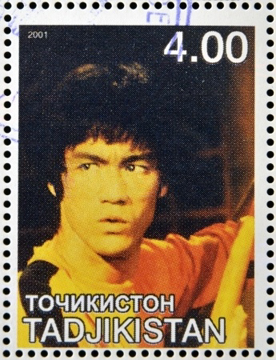
Photo of Republic of Tajikistan stamp at Wikimedia Commons.
| The
Gospel According To Bruce Lee David Cameron © Copyright 2026 by David Cameron |
Photo of Republic of Tajikistan stamp at Wikimedia Commons. |
Shoving
hard, I lost
my balance as the door gave way, and my clean clothes tumbled to the
floor, tossing everything into a heap. Hearing my nosy neighbor’s
door open down the hall, I kicked the pile into my apartment and
closed myself in.
My
apartment was in the old downtown Sarsfield Hotel, long ago closed to
travelers and carved up into a beauty shop and an insurance office on
the ground floor and Spartan apartments on the floors above. I didn’t
mind Spartan. My building had no laundry facilities, but I
was young, single,
and
well-practiced in
schlepping laundry off-site. Luxury
wasn’t my thing.
In
the morning, when I rushed out the door, my basket overflowed with
dirty clothes. In my second week as a pastoral intern at Bethesda
Presbyterian Church, I was down to my last clean shirt. Time to wash.
After
work, my pockets bulging with quarters, I drove a mile to a
laundromat
I had seen the day before.
Lugging
my
laundry
to the front door,
I
waited for a patron to exit, caught the closing door with my foot,
executed a deft pivot, and entered the steamy interior. Already
sweating in the late afternoon sauna,
my
body’s spigots opened full blast in response to the thermal
assault from chugging washers and spinning dryers.
I
was focused on finding an open washer, so I didn’t
realize at first that I was not only the lone man in the place but
also the lone white person.
Then I
did. I stood still as a post, waiting for the space/time continuum to
splinter from my brazen disregard for social norms.
Why
was I nervous? It
was 1980, for Pete’s sake; 16 years since Congress passed the
Civil Rights Act as an emphatic No! to segregation. It had been three
years since Alex Haley’s ground-breaking miniseries Roots
gripped the nation with its portrayal of slavery and repudiation of a
romanticized Old South gentility. Inroads, baby! Inroads!
Still,
having
grown up in North Carolina, I knew well enough that, in the South,
status quo was king and self-preservation a powerful driving force.
Sure, integration got lip service, and celebrations of unity made
local headlines. MLK Jr.’s legacy notwithstanding, however,
most people in the South still clung tightly to familiar patterns of
racial division like a comfortable old pair of brogans.
I
had crashed the sacrosanct color barrier in that laundromat.
Flinching, I expected bells to clang, sirens to blare, but nothing
happened. To their credit, no one in that concrete block sweat palace
openly objected to my presence.
A
tall,
thin woman gave me the once-over and then pointed with her chin to an
empty washer.
Once
I got past the initial shock of my minority status, white privilege
kicked in, and I started imagining myself a noble
ambassador
of racial rapprochement; an
ivory Prince of Tide in their ebony Queendom of Clean. Contrary to my
lofty self-image, I later learned that my abrupt invasion
of
their protected space had been viewed either as a sign of the
apocalypse or as proof I was one crazy cracker.
I
truly don’t
know why they cut
me
slack. If I have to guess, it’s because they were generous and
I was clearly inept; obviously inferior in all the ways that counted.
For
example, addressing the empty washer, I started throwing white
T-shirts in with dark Levi’s. That’s when Joan lightly
touched my shoulder and said, "Honey, may I make a suggestion?"
As
I learned on subsequent visits, Joan
was
the queen bee of the group and always good for
wisdom
or a laugh. A
big woman with a towel slung over her shoulder to wipe perspiration
from her eyes, she radiated kindness but also fierceness. You could
tell Joan had seen some stuff done some, too.
James
Brown belted out "It’s
a Man’s
World" over tinny speakers as my clothes washed. Wiping the
sweat coursing down her mocha cheeks, Joan grunted,
"Huh,
it’s
a man’s
world only 'cause we let it be." She looked at me when she said
it, daring my rebuttal.
When
night fell,
I felt
lonely in my new town. My apartment faced the main drag across from a
movie theater showing
Enter
the Dragon
starring Bruce Lee, and I pulled my recliner to the large front
window. It had finally grown cooler, and I left the lights off to
avoid adding even a fraction of a degree.
In
the dark, I was
anonymous. Snacking on
Doritos
and drinking Sprite, I watched movie patrons spill onto the sidewalk,
practicing the martial arts moves they'd just seen. These are beefy
white boys with farmers’
tans
and skinny teens in heavy Doc Martens emulating, as best they can,
Lee’s
cat-like dexterity.
There
were even a few black faces in the group.
I
was lonely, and as I watched insects swarm the street lights outside,
a drop of perspiration rolled down my nose. Wiping it with a
forefinger, I smiled as I thought of Joan and her ever-present sweat
towel, her kind eyes, and her refusal to take life on anyone’s
terms but her own.
At
this point, I didn’t
have any idea what my intern year would bring in the way of new
friends and experiences. For example, that first day in the
laundromat, I couldn’t know that every other Monday with The
Ladies would become one of my favorite things about Camden. But Bruce
Lee might have predicted it. Besides being a quintessential ass
kicker, he was also a font of wisdom. It was Bruce who said, "You
can never invite the wind, but leave the window open."