There’s
a
knock at the door; the lightest rapping of knuckles on weathered
wood. We freeze, looking toward the door and then at each other. We
are five teenage boys who had been dropped off two days earlier at a
mountain cabin. 48 hours have passed, and we are still astonished to
find ourselves living the adventure fantasy of suburban 13-year-olds
everywhere—on our own with no adult in sight. But the knock
surprises us. Who, besides our parents, even knows we’re there?
That
we are there is a sign of our parents’ trust, that or their
desperation to get us out of their hair for a weekend. All five of us
are Scouts, so they know we can splint a broken bone, make a
stretcher from tree branches, and do the Heimlich maneuver if
necessary. As for feeding ourselves, beef stew requires only a can
opener, and Pop-Tarts nothing at all. I have a special talent for
cooking, but I’ll get to that.
We
are friends, some of us close and others friends in the way of kids
who attend the same school and fart around together on the bus or
between classes. Brian is the earnest one, always out to save the
whales or join the “Racial Harmony Rap Group.” Loren has
a pet raccoon, and when we are at his house, his dad pokes his head
in the room and vows good-naturedly to “take us down a notch or
two.” Stan is goofy, but he can be distant, too, like he always
has plans that don’t include us. Gilbert is a redheaded kid who
grins a lot and is spring-loaded for fun.
I
am the one with a stick up my rear—the youngest of three
siblings who, early on, developed the strategy of good behavior as
the ticket to parental approval. There is no commandment of God or
man I don’t fear breaking. But I’m also a romantic,
eagerly absorbing tales of chivalry, imagining myself the hero who
will win the favor of a young woman through heroic deeds and
sacrifice.
At
13, I’m in the middle of a wicked hormonal onslaught manifested
by a disorienting growth spurt and a cracking voice. Dreamy, awkward,
and feeling my pre-pubescent self-confidence slipping away, I still
manage a positive attitude most of the time. I continue to hold out
hope for something epic.
It
is the summer of 1970. Bridge
Over Troubled Water
is on our turntables. The haunting image of a crying woman kneeling
over a dead student at Kent State is fresh in our minds. Nixon’s
War on Drugs is still a year away, and while several on our weekend
jaunt will become regular partakers of cannabis, I don’t think
any have crossed that threshold yet.
When
we first arrive at the small, tidy cabin, we put the weekend’s
groceries away, claim our bunks, and go out to explore the woods and
the nearby creek. Grasshoppers catapult from stem to blade. Wrens and
goldfinches dart in and out of shrubbery. I notice a patch of ripe
blackberries and file the information away for later.
I’ve
always been at home in nature. It’s a blank canvas for the
imagination, and as five boys heavily influenced by grim TV
dispatches from the Vietnam battlefield, our imaginations soon steer
us toward pretend violence. Downed tree limbs become M16 rifles. Pine
cones are grenades heaved with pinpoint accuracy as we dive behind
boulders or into ravines, all while laying down covering fire for our
fellow soldiers. No mothers are around to chide us for glorifying
death. No fathers lecture us on the politics of war.
Having
secured victory for the Good Guys, we decide to walk down a dirt road
to a little country store. Cokes and candy bars are just rewards for
brave fighting men.
On
the way to the store and back, we tell stupid jokes, deliver witty
put-downs, and discuss the hot girls in our class we are in love
with. The worldly among us fantasize about sexual encounters they’ve
only read about. Being hopelessly inexperienced and naïve, I
listen eagerly but offer no opinions.
We
also practice our cursing with liberal applications of “Damn”
and “Hell. Most of all, we laugh. We bark and giggle and
guffaw, intoxicated by the absolute freedom of the moment.
When
we return to the cabin, I quietly check the kitchen pantry for
supplies. Finding what I need, I make a general announcement that I
am going outside. I track down the ripe blackberries I spotted
earlier and pick a potful. While
the others read Mad Magazine or play board games, I create a
blackberry cobbler. I feel capable. My mother, a consummate baker of
good things, taught me the steps just a week earlier.
It
does occur to me that, in 1970, a teenage boy must be careful with
his image. A teenage boy risks ridicule if he admits he can cook
anything more complicated than a peanut butter and banana sandwich.
Macho don’t cook. But I play center on the school basketball
team, so I’m pretty sure that will blunt any ribbing. Besides,
it’s a tasty confection I produce for dessert that night, and
my buddies are too busy shoveling it down to talk smack.
The
next morning, we go out again to explore, turning left on the dirt
road in the opposite direction from the store. The sun is warm on our
necks, and our shoes kick up dust. We’re in a more sober,
reflective mood than the day before.
Someone
brings up the draft lottery. Everyone knows a young man, a brother or
a cousin between 19 and 26, who is eligible for the draft. We had sat
with our families around the TV the previous December, watching as
numbered balls were drawn from a large bin and matched to each day of
the year. If your birthday matched number 302 of 366, you might not
have to fight the Vietcong. A low number match meant you were toast.
As we walk, we assure ourselves that the war can’t
last six more years. Can it?
We
soon pass a modest frame house with a large front porch. It is
weathered but sturdy and flanked by a vegetable garden bearing
tomatoes, beans, squash, and corn. As we walk by, a tall girl who
looks to be our age glides out onto the porch and sits in a rocker.
Self-possessed, her movements are slow and smooth. She has straight,
brown hair, high cheekbones, and is wearing a faded cotton dress. A
little gaunt, but pretty, she is, for lack of a more imaginative
descriptor, a mountain girl.
You
would think us a choir whose director has just given the signal for
silence, the way we abruptly quit talking. My radar is on high alert,
like it is anytime a girl is nearby. I immediately began spinning a
romantic tale in my head featuring me as the hero who would take this
mountain girl back to civilization and show her how, through the
modern conveniences of city life, she can blossom into the full
expression of self-reliant womanhood. I never consider that, as a
girl growing up in rural Appalachia, she is probably more
self-reliant than I will ever be.
My
buddies indulge their own fantasies as we walk by, poking and
jostling each other while trying not to laugh. As we pass, Brian
points to me and calls out, “He can cook!” I blush hard.
The girl’s expression doesn’t change.
That
night, as I’m drifting off to sleep, I think of the girl. I
wonder where she goes to school. I wonder if she noticed me when we
walked by. I’m surprised my friends didn’t lapse into
crude speculation later about whether she would let them get to
second base the way they had ruminated over our classmates back home.
It is as though she is a different order of girl, even a different
species like Commander James T. Kirk might discover living on a
distant but not hostile planet.
When
the knock on the door comes, we are packing and getting ready to be
picked up later that morning for the two-hour ride back home. In a
subdued frame of mind, we are grateful for the time we’ve had
together but ready to return to our regular lives, despite the
parental oversight that portends.
When
the tapping sounds, we freeze and look at each other. I leap to the
conclusion that it’s the local sheriff come to rebuke us for an
unwitting breach of community norms: someone heard me say "crap"
at that little store, or we drained the power grid of too much
electricity. Since I’m the closest to the door, I get the
unanimous nod to answer it.
Taking
a deep breath and remembering that, among other things, a Scout is
brave, I open the main door. There, looking at me through the
screened door, stands the one I have come to know in my imagination
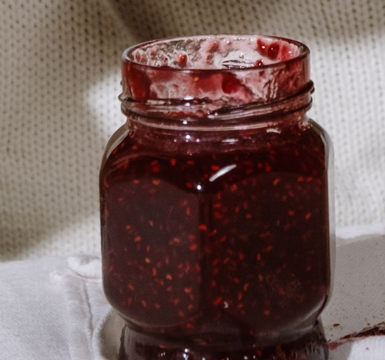
as Mountain Girl. She is holding a jar of strawberry jam.
Frozen
for a moment, I then push open the screen door. Forcing air from my
diaphragm over my vocal cords and past my lips, I manage to say,
"Hi."
"Hi,"
She says in return. “Mama told me I should bring this over to
you boys. She heard you was staying here.” She holds out the
jar.
Later,
on
the drive home, I berate myself. Why didn’t I ask her name when
I had the chance and tell her mine? Why didn’t I ask how old
she was? Why didn’t I ask if I could write to her? Why didn’t
I ask if she could move to my town, even to my street, and we could
see each other every day and ride to school together? Like I told
you, I’m a romantic. Reality seldom intrudes into my daydreams.
Besides, it’s summer. Anything seems possible when it’s
summer.
After
a career as
a Presbyterian minister and a marriage and family therapist,
David Cameron writes stories and poems in the mountains of Western
North Carolina where he lives with his spouse, Kathryn and
son,
Will. His work has appeared in Razor Magazine, Pensive Journal, Rural
Fiction Magazine, Hemlock Journal, and the Toasted Cheese Journal,
among others