Beautiful Konglor
Derek Stokes
©
Copyright 2026 by Derek Stokes

|
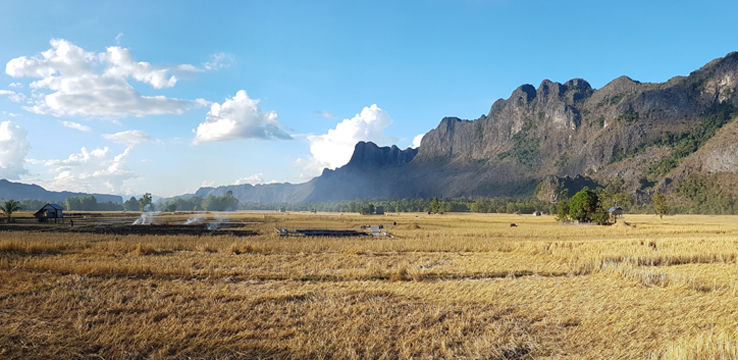
Photo courtesy of the author. |
Konglor,
Konglor, Konglor – so good I named it thrice!
What
can I possibly write about Konglor that hasn’t been written already
(by me) about this glorious little village, this tiny peaceful haven
of natural beauty. Well, probably an enormous amount as it turns out.
A lot more than most people, because very few actually spend more
than about eighteen hours here. They do so both as an overnight on
the Thakhek loop, and to explore the famous cave. Arrive in the
evening, get up early to see the cave and gone before midday, without
taking any time to enjoy it completely, is the typical itinerary for
the vast majority of visitors.
For
those who linger, they are delightfully rewarded. Konglor is an
exquisitely beautiful location in central Laos, set at the end of a
naturally fortified valley, with towering cliff faces serenely
embracing its magnificent tranquillity.
This
is my third sojourn to Konglor, and each time it has knocked my
flip-flops off and inspired me to put pen to paper. I don’t know if
the majestic scenery, the incredible peace, or the wonderful people
come in any particular order of preference; some moments I bask in
the silence, next thing I know I am grinning to ear to ear whilst
waving and smiling to the fantastically friendly and warm locals, and
just earlier today as I was gaping at the, quite frankly, astonishing
backdrop, my eyes teared up and I almost began to cry. It stirs my
soul.
I’m
pretty sure it is my favourite place on Earth.
As
I mentioned, this is indeed my third visit, but my first in the rainy
season, and it was absolutely teeming down when I arrived yesterday.
Today, the sweat is pouring out of me as the searing sun blazes high
above in the almost cloudless azure sky, the odd wafer-thin white
cloud is nudged around by a barely perceptible breeze.
I
stand here in the shade of a rather large, and thankfully, leafy
tree, the almost absolute silence is not punctured, not interrupted,
but complemented by the profoundly soothing sounds of nature. The
distant crow of a rooster, who clearly has no clock - ‘tis far from
the break of day (or maybe it’s just the almost timeless quality
that Konglor exudes, that has him so confused), the quacks of some
nearby ducks, as they waddle about their business of doing very
little at all, the shrill melody of a couple of birds singing in a
tree, the tinkle of a bell on a cow or water-buffalo, as they slowly
sludge themselves into a muddy waterhole to cool off. In a way, the
village is more like a small farm than the lazy hamlet that it is.
Even
the fish and the frogs get in on the act, causing the odd ripple and
swish in the waters of the rice fields that now occupy the spaces
where the verdant green of tobacco plants so vibrantly grace the
valley during the dry season.
And
somewhere, very close by, an unexpected grunt from an expertly
camouflaged pig. And all the while, that almost silent and
imperceptible rustle of the rice as the breeze hushes airily across
the valley, bringing sweet relief from the intense heat. A friendly
butterfly bumbles along and settles down for a rest upon my shoulder.
It
really is idyllic. It feels like every perfect sunny summer’s
evening from our childhood (OK, mine), when everything was simpler.
The sun seemed to shine every day, computers only existed in sci-fi
movies about a distant future, and even then they were the size of a
small Eastern European country that did not yet exist because the
U.S.S.R had yet to break up. When building hay-jumps and tree-forts
were the days activities, until we went home for our tea at six
o’clock.
We’d
gobble it up as quickly as we could, because there was a game of
tip-the-can, or football in the park, starting at seven o’clock;
each team usually consisting of about four-hundred-and-twenty-seven
players, all playing centre forward, and the local nerd stuck in
goals.
Those
halcyon days are long since lost. Not just to us, but to modern
childhood, unfortunately. Many kids no longer experience fresh air,
to many the outdoors is a foreign universe, theirs being screens and
headsets.
Anyway,
enough reminiscing, back to the wonderful here and now, and the
amazing nature of Konglor.
Maybe
its a metaphor for the last fifty years that I have been alive, and
how the world has changed in that time, but truly as I sit here now,
the sun has just dropped behind the western cliff-face, the
mosquitoes are beginning to attack, and the distant rumble of thunder
approaches rapidly. The temperature has dropped, and there is that
ominous ‘calm before the storm’ feel to the atmosphere.
To
the east, the upper reaches of the cliffs are still bathed in
glorious sunlight, but above and beyond them, seriously
petulant-looking, dark clouds are laden down with impending trouble
and menace.
That’s
no longer a gentle breeze, that’s a strong wind – rain’s
a-coming.
Wow!
This is incredible. The cliffs have just completely disappeared from
view, in their place is cloud and sheets of rain hammering down and
sideways! Thunder’s a-bellowing, wind’s a-howling … this is
seriously violent and extremely sudden. Day has become almost night,
the trees are being whipped asunder, the rice is being flattened, the
birds have fallen silent and the noise of all of it has shattered the
serenity. Nature is having an enormous tantrum!
It’s
mental, bonkers, mad, insane, nuts. All of that.
Out
to the west, the sky is still blue. Calm, sedate, serene, evening
blue.
And
just like that, it’s all very abruptly over. It has passed, leaving
only pure silence in it’s wake. I am breathless. That was
phenomenal. Wow. Just … wow!
Nature:
beautiful, peaceful, serene, angry, violent, powerful.
What
a thing to behold. And to preserve and save, not destroy as so many
are trying to do in the name of progress. Something tells me that
nature will still be going strong along her merry way long after we
have wiped out the human race, and she will be glad to see the back
of us.
I was born in Dublin, Ireland, a town which I still call home,
despite not having lived there full-time for almost ten years. I have
spent most of that time travelling throughout South East Asia,
including pre-war Myanmar, and writing about my experiences.
(Unless
you
type
the
author's name
in
the subject
line
of the message
we
won't know where to send it.)
*****
If the
link to the letter doesn't work you can copy
and paste in this address: preserve@storyhouse.org
Book
Case
Home
Page
The
Preservation Foundation, Inc., A Nonprofit Book Publisher