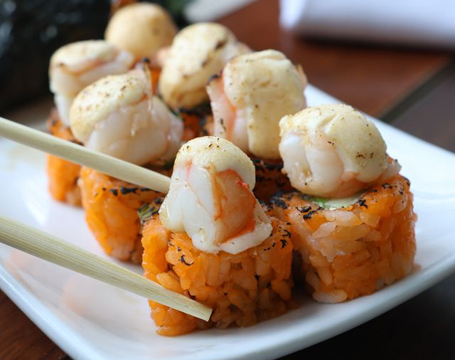
Nikkei
style cooking, the fusion of Japanese and Peruvian cuisines, is a big
part of the gastronomic heritage of Peruvian culture. This cooking
style tells a story of immigration and making a home far away from
home through the resilience to new flavors while maintaining
traditional techniques. This
story aims to give an insight on the origins of a Peruvian Japanese
fusion dish called “tiradito”. By understanding the
historical background of both Perú and Japan which allowed for
this style of cooking to emerge, the story unveils centuries-old
flavors and techniques that innovate into the gastronomical method of
Nikkei cooking.
Growing
up, my favorite food was sushi. With my family, we would go to this
one Japanese restaurant a few blocks from our house every other
weekend and we knew our order by heart: two yakimeshi orders, one
shrimp tempura, half a tray of California rolls and half spicy tuna,
one tray of ‘acevichado’ rolls and one ‘ceviche
Nikkei style’ platter. All these dishes constituted a
commonplace meal we would have at a Japanese restaurant in Peru.
When I moved to Canada, however, I realized this wasn’t the
case outside of Peru.
Turns
out, the flavors that I’d come to recognize as Japanese weren’t
authentically Japanese. Later, I came to understand that what I had
known as Japanese food was, in reality, Nikkei style cooking.
The
word Nikkei comes from the kanji “日経” which
literally translates to ‘children of the sun’ and often
refers to Japanese emigrants and their descendants. In Peru, Nikkei
adopts a different meaning given the influence of Peruvian Japanese
fusion style cuisine that has developed over the last century.
But
how come two countries that are divided by the vast Pacific Ocean are
able to share such a rich cultural heritage that we’ve had to
give its food a name?
It
all starts in the second half of the XIX century, in Japan it was the
Meiji era, and in Peru the Aristocratic Republic. Back then, both
countries were dealing with complimentary issues. On one hand, Japan
had an overpopulation problem which was worsening unemployment
indexes. On the other, Peru had an emergent sugarcane and cotton
industries in their coast but no labor to sustain it.
Therefore,
under the then president, Augusto B. Leguía, the Peruvian
government gave green light to the immigration of Japanese people
under a job contract. Between 1899 and 1923 around 18 000 Japanese
people immigrated to Peruvian coasts to work in agricultural labor.
And, after this first wave, in 1924, immigration was opened to people
without a contract, and the families of those first immigrants were
able to join them after they had already established themselves in
the country.
Over
time, Japanese people and their descendants, were able to adapt their
own cooking styles to Peruvian flavors and ingredients in search for
a home away from home.
Let’s
take a look at a dish called “tiradito”, for instance,
which most local Japanese and Peruvian restaurants will sell in the
Peruvian coast. The dish is said to be a fusion between the Peruvian
ceviche and the traditional Japanese sashimi.
Its
name comes from the word “estirado”, which means
stretched, and refers to the longish strips in which fish is cut. The
dish combines Japanese style cuts of sashimi and the method of
“cooking” the raw fish in lemon popularized in Peru.
It
sounds simple when presented as the product of its parts, but the
history of both dishes lies in the development of ancient
civilizations.
The
dish ceviche is said to have been created some 1700 years ago with
the pre-Hispanic culture of the Mochicas in the northern coast of
Peru.
In
their time, ceviche was cooked in a marginally different way than
what we understand ceviche to be today. The fish, instead of being
prepared with lemon, was prepared with a citric fruit called “tumbo”
or with “chicha”, a type of beer made from fruits or
cereals.
Time
went by and when the Spanish arrived disrupting the Inca Empire, they
introduced fruits like lemon, and a type of sour orange, not only to
give the fish flavor but also for its conservation. From then on,
lemon became the main ingredient to simulate cooking the raw fish.
After, red onion, sweet potato and choclo,
a type of corn
indigenous to Peru, were added to make the dish a more complete meal.
In
the case of sashimi (“刺身”),
while there has been record of Japanese people eating raw fish as
early as the 8th century, initially it was called namasu (“鱠”). This
this was constituted by thinly sliced pieces of raw fish dressed with
vinegar.
The
practice and art of sashimi, which means pierced or
sliced
flesh or meat, was established during the Edo period (1603-1868). The
thinly sliced pieces became bite size as to be easy to grab with
chopsticks and, instead of being drenched in vinegar, the fish was
dipped in soy sauce and topped with wasabi.
Because
of the simplicity of the dish, its mastery relied heavily on the
freshness of the fish and the skill to cut the fish to perfection.
This cut was done with a hôchô (“包丁”),
a Japanese kitchen knife, which was exclusively yielded by
the itamae (“板前”),
the chief cook, or he who, as the name literally implies, stands
“before the board”.
Together,
Peruvian and Japanese influences created a dish that had the
satisfying sting of the pungent lemon juice but also the care and
skill of the knife.
Over
time, Nikkei cooks have innovated and given the simple dish some
variations. For instance, instead of marinating the fish in lemon
juice, some drench it in a cream of ají Amarillo. Ají
Amarillo, or Peruvian Yellow Chili Pepper, is part of the Peruvian
cuisine “holy trinity” along with red onion and garlic.
This variation of the tiradito complements the lemon juice with a
fruitier flavor and bright yellow color. And, while the Ají
Amarillo is a bit spicy, it has nothing on the variation of tiradito
with Rocoto peppers. Rocoto, also a staple in Peruvian cuisine, give
the dish a striking orange color and crisper almost grassy flavor.
Given the different flavor profiles, restaurants will often serve
them as a trio: “Tiradito Tricolor”.
Another
variation created, and often included with the trio, is a sauce with
black olives, fruits that, dissimilar to ají Amarillo and
Rocoto which are indigenous to South America, were brought to America
by Cristopher Columbus. The olives balance the pungent flavors of the
lemon and chilis by providing a softer and slightly bitter taste
while introducing a creamier texture given their meatier consistency.
In
this way, the ‘tiradito’ isn’t the story of one
people but of multiple, and how they were able to meet in the middle
and produce something different.
Together,
method and flavor, create a dish that not only transcends country
borders, but it speaks of a hybridity identity that most, if not all,
Peruvian people possess today. Whether it is Peruvian indigenous,
Spanish colonizer or European, Japanese, Afro-Peruvian, or the
product of all of them, without this history, despite its oftentimes
destructive nature, we wouldn’t have the gastronomic diversity
that we do today.
In
this way, I understood I was right. I wasn’t eating authentic
Japanese food. But that didn’t make it any less authentic. My
sense of authenticity was displaced. Nikkei style cooking is
authentic for the descendants of those first Japanese immigrants who
made a home of this foreign country, who worked its land, and who
innovated to make this new place feel like home in a territory that,
generations later, is rightfully theirs as well.
My
name is Dharma Caceres, a student at the University Toronto
Mississauga currently in my third year of undergrad for a double
major in Professional Writing and Communications and English. I was
born in Canada but lived in Peru for most of my life until I moved
back to pursue post-secondary education. I don’t have any
publications submitted yet, but I believe this contest would be a
great place to take my first steps toward a writing career.