Lightning, Thunder, Rain, and Sand; Lost!
Garth Wigle
© Copyright 2026 by Garth Wigle

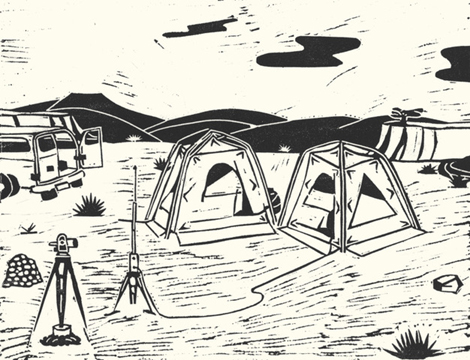
Base camp in Tripoli, Libya, etching by the author
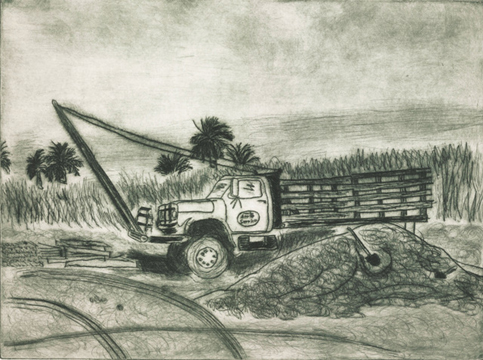
Libyan desert print by the author
Lightning, Thunder, Rain, and Sand; Lost!Garth Wigle © Copyright 2026 by Garth Wigle |
Base camp in Tripoli, Libya, etching by the author | Libyan desert print by the author |
I was a better forecaster before I studied meteorology than I am today. Over the years, I have decoded MAFOR messages (marine forecasts), ballistic met messages, aviation weather products. All rendered in their unique codes.
My meteorological studies didn’t formally begin until I joined Transport Canada in 1989.
The Early Days
In 1973 I began studying Marine Navigation Technology at Georgian College, Owen Sound campus. An essential element of safely guiding a vessel on water is knowing what to expect for weather along the way. Weather forecasts were broadcast on marine radio frequencies in MAFOR code. I learned to decipher those messages in order to have an idea of what weather to expect en route. A handy talent as I was assigned to spend the summer sailing the Great Lakes aboard Canada Steamship Lines’ SS Murray Bay, a bulk freighter.
In the Artillery (1972-1982), I learned wind at altitude can have a huge impact on the trajectory of projectiles. I learned to decipher ballistic met messages in order know where the projectiles would be carried and to determine the corrections to apply to ensure rounds landed on target.
While in the Artillery I also discovered that I could recognize approaching stormy weather. In the field I knew when to seek shelter before the rain/snow/etc hit or ground the radios before the thunder and lightning arrived (without the aid of meteorological forecast products). In garrison, I knew when it was time to leave the Mess and return to my quarters before the weather arrived.
Libyan Sahara
From December 1982-June 1983 I worked as a surveyor on a mapping project in the Libyan Sahara. One day in January ‘83 I was in the town of Nalut on the escarpment a few miles inland from the Mediterranean. The clouds were heavy, low and grey. The wind was strong and the temperature was dropping. I was talking to a Canadian colleague (from Calgary) who was at our office in Tripoli. He asked what I thought of the weather. I said, “I wouldn’t be surprised if we get snow soon.” My 34-yearold Libyan liaison said, “Oh no, no snow. Never snow in Libya.” Later that day we got four inches of snow! The first snowfall in 35 years! (They got more snow in 2017-18, another 35ish years.)
As winter gave way to spring and sandstorm season, I always knew (I have no idea how) 24-48 hours before the sandstorm hit that it was coming. The first time it happened I knew something was coming but didn’t know what. About 36 hours later the sandstorm blew in. After that first episode I knew to expect a sandstorm when I got that “feeling” again.
Darj Journey
One particularly memorable day one of my crew members and I had to drive 125 miles from the station we had just set up at into the nearest town, Darj, to pick up supplies and meet our project manager and the Director General of Surveys in the Libyan government (our client) who were visiting the various survey crews in the desert. Before we left the site, I told Charlie, the Irishman I was leaving at the site with our Libyan crew, that I was expecting a sandstorm within the next day or so. I instructed him to bring in the omni beacons we were using for our azimuth by Polaris observations when the wind started to pick up so they wouldn’t be damaged in the storm.
The crewman that was accompanying me to Darj and I set out in the Chevy Suburban for the nominal 4-hour trek. A couple of hours into the drive the wind howled and the sand swirled. I said, “I hope Charlie has picked up the omni beacons, but I doubt it.” (Charlie was an industrious worker as long as someone stood over his shoulder telling him it was time to do whatever task needed doing. He couldn’t seem to remember conditional instructions for a future event.)
Eventually, the sand was so thick I couldn’t see the hood of the Suburban! Then the boss called wondering where we were. I told him we were on our way, slowly, due to near zero visibility. He didn’t believe me, since where they were in Darj, a town near an oasis, was still in blue skies and light wind. He finally said, “Fine, get here when you can.”
As we descended the escarpment into Darj, the weather finally cleared. When we met up with the boss and the client, I looked at the wall of sand approaching town and said, “Tony, that is what we just drove through.” The client and his entourage, and my mate and I dove for cover. Tony ran to get his camera thinking he might take pictures!
When the sukh opened after the lunch break, we got our supplies (with the assistance of the client, as the shop owner was reluctant to open for us.) We then set out to return to the station. By now it was dusk, the sand still blowing, visibility dropped again to near zero as we mounted the escarpment to head back to the station — not knowing what awaited us.
Shortly after we were back up on the plateau above Darj, the temperature and humidity shot up. I said, “If I was back home now, I would say it’s going to rain in about half an hour!” My mate said, “Rain?!? We’re in the desert!” I reiterated, “If I was back home.” Twenty-seven minutes later, now full dark, the heavens lit up, thunder roared, rain mixed with the sand hit the windshield as mud!
We continued to drive toward the station. We managed to find the Darj-Idri road, an east-west dirt track about 400 miles long. However, we missed the well and the mile marker at which we should have turned south to get to the station. As midnight approached the thunder, lightning, rain and wind all abated. The stars shone in a cloudless sky. I was fairly certain that Charlie would not have taken the omni beacons in as instructed. I believed that had they survived the storm, I should be able to see them from the roof of my Suburban and thus find my way to the station. I drove to the top of a hill, stopped and got onto the roof of the Suburban. Nothing. I talked to the boss and the client. We decided the safest course of action would be to stop where we were for the night and pick up the search for the station in the morning. My crewman and I decided to sleep in the back of the Suburban while our travel companions opted to sleep under the stars. Half an hour after we bedded down we were rudely awakened by the horrendously loud drumming of the next rain storm on the roof of the Suburban. We looked out and watched our travel partners scrambling for cover!
We Made It!
The next morning dawned sunny, clear, and calm. We started to follow a “road” that headed north to find our way back to the Darj-Idri road. The road veered east and I kept going north. The client stopped me and said the road goes this way (the Libyans love to drive on the “roads” even if they are not going in the direction they want). I said, “I know the Darj-Idri road is north of us. When I get to it and find a milestone, I will know where I am and which direction to take to get back to the well that will get me to the station.” His response to that was to get back in his Suburban and fly north at top speed. I managed to keep up.
We got to the Darj-Idri road, found a milestone that confirmed I had travelled too far east, past the well where I should have turned. We drove west, found the well, turned south looking for our tire tracks from the day before where we had left the road to find the site for the station. Unfortunately, with all the wind, sand, and rain overnight, we couldn’t distinguish our tire tracks from those created by the Germans and Allies in the Second World War! As we passed a second old survey marker, I looked at my partner and said. “I don’t remember passing two survey markers yesterday. I think it is time to turn east.” At the same time, the boss was signalling me to stop. He said, “Can you not hear Charlie? He is trying to call on the shortwave.” (We had two frequencies we used: one for night and one during the day. As the sun was up, I had changed to the day frequency — obviously