Present Signature
Jatin Garg

© Copyright 2026 by Jatin Garg
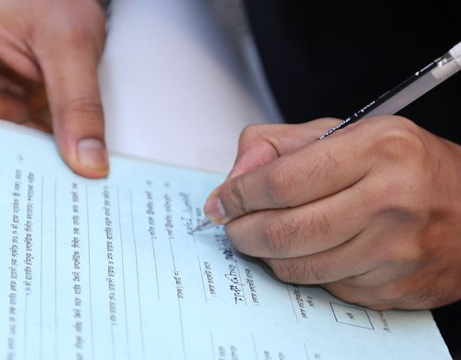
Photo by Naimul Islam Joy at Pexels.
Present SignatureJatin Garg © Copyright 2026 by Jatin Garg |
Photo by Naimul Islam Joy at Pexels. |
On the morning of 7 November 2024, my grandfather signed his name eleven times on the back of an electricity bill.
He had made a column of signatures down the unused half of the paper. The first B. M. Mathur leaned forward and finished with the long underline I knew from birthday cheques and school permission forms. By the seventh attempt, the letters stood apart. The eleventh underline stopped under the h, as if the pen had run into something.
Nana held the sheet at arm’s length. He was wearing his reading glasses over his regular glasses, a system that worked for him and alarmed everyone else.
“Which one is the new signature?” I asked.
“There is no new signature.”
He folded the electricity bill once and placed it in his document file.
It was the week after Diwali. I was twenty-nine and working from my mother’s dining table in Lucknow. My 3:35 train to Delhi left Lucknow Junction that afternoon; at 9:30 the next morning, I was due to present three months of research to a client.
Every November, Nana submitted an annual life certificate to keep his railway pension payments coming. He had always gone without me, but that morning my mother saw him practising after breakfast and decided he needed company.
“Two hours,” she told me before leaving for work. “Take your suitcase. Go straight to the station from the bank.”
Nana objected to this arrangement. He was seventy-nine, not housebound, and capable of travelling four kilometres without a committee. The branch had changed its pension clerk since the previous November. At breakfast, his right hand had made the teaspoon ring against his cup.
“I only need someone to watch the luggage,” he said.
The luggage was one cabin-size suitcase.
His green board file, its corners rounded by use, closed with cotton tape. Inside, a blue-ink index listed his Pension Payment Order, passbook, identity copies, photographs, November certificate sheet, last year’s acknowledgement and spare paper. The spare paper had no number because, he said, it was not an enclosure.
An envelope marked RECEIVINGS held stamped acknowledgements from banks, the railway accounts office and the municipal water department. Nana called any stamped proof of submission a receiving.
He had retired in 2004 as a senior clerk in a Northern Railway divisional office. I grew up among its remains: green thread, carbon sheets, service-rule booklets and the backs of office circulars used for grocery lists.
Before nine, I showed him my ticket and said we had to leave the bank by two. He said that by two I should already be near the station and that the bank would take twenty minutes if the papers were in order.
I pointed at the electricity bill. He slipped a black ballpoint into the file’s spine. “Those were warm-up signatures.”
We left Indira Nagar shortly after nine. Nana carried the file under his arm, and I pulled my suitcase behind us. He rejected the first auto-rickshaw because its side curtain was torn and the second because the driver quoted a round figure. In the third, he sat with the file flat across his knees and asked the driver to avoid a road that had been dug up for sewer work in August. The driver said it had been repaired. Nana asked when. I watched shop shutters rise along the road and let the two of them settle it.
The branch that paid Nana’s pension occupied the ground floor of a building with a coaching centre above it. Only one counter had begun calling tokens. Plastic chairs faced an electronic board that displayed A014 in red. Our slip said A029. A handwritten notice reading PENSIONERS — LIFE CERTIFICATE directed us to counter four.
Nana called the token unnecessary. The guard, who was helping a man coax a passbook into the printing kiosk, explained that counter four used the same token despite having a separate queue. Nana looked at the notice, then at the token, and put the token in the file.
We took two chairs beside a pillar. My suitcase stood between my knees. Around us, other pensioners opened plastic folders and compared photocopies. An elderly man kept his passport photographs in a matchbox so they would not bend. Most people had brought more paper than the notice required.
A little after ten, counter four opened. A clerk in a rust-coloured shawl switched on her computer and arranged a date stamp, a round branch seal and a red pad beside the keyboard. Her nameplate read FARAH ANSARI. The queue moved quickly at first. One man had come without a PPO number and telephoned his son. Ms Ansari gave him a blank slip, told him what to ask for and moved to the next token.
Nana timed three customers on his watch. When I told him to stop, he said he was only looking at the time.
When A029 appeared, Nana stood before the bell finished sounding.
He placed the November certificate sheet and his PPO copy on the counter. I parked the suitcase against the desk and stood beside him.
The railway form combined two requirements: an annual certificate confirming that an authorised officer had seen him alive, and a half-yearly declaration that he had not returned to work. Nana had crossed out the inapplicable choices and signed at the bottom.
Ms Ansari checked the PPO number against the passbook. She compared Nana with the photograph in the bank record, asked his date of birth and entered something into the computer. The life certificate itself caused no trouble. He was standing in front of her, answering for himself. She set it to one side for an officer’s signature.
Then she reached the non-employment declaration.
Ms Ansari asked him to sign again in her presence. Nana said he already had, but took out the black pen.
He rested the heel of his hand on the counter and wrote more slowly than he had at home. The B opened too wide. He stopped after the initials, shifted his wrist and completed Mathur. His old underline followed, but it dipped before rising.
Ms Ansari studied the form, then opened a scanned image on her screen.
She enlarged the image and turned the monitor towards us.
The 2004 signature was compact and joined. The initials nearly touched, Mathur climbed slightly to the right, and the underline returned across the t. The new one followed the same shape more slowly. Its letters stood apart, and the underline fell short.
Nana said it was the same. Ms Ansari said it was quite different and asked him to try again naturally.
“That was natural.”
She gave him a fresh sheet of plain paper. He tried again. This time he was copying the old signature on the monitor. The initials came out cramped. He paused before the surname, leaving a gap that did not exist in either version.
Without criticising it, Ms Ansari asked him to try once more without looking at the screen.
Nana turned his chair slightly away from the monitor and signed. The result was closer to the version on the electricity bill than to the bank’s specimen.
“It is my signature,” he said. “My hand is slower, that’s all.”
She explained that she could record a new specimen, but only after a senior officer had verified his identity and witnessed it. Nana pointed out that he had brought identification.
She named the documents she needed. Nana had every one of them and began laying out the originals with their photocopies. When I reached for his Aadhaar card, he moved it out of my hand and placed it himself.
Ms Ansari took a customer request form from a drawer and said the branch might accept a witnessed left-thumb impression, though a senior officer would still have to identify him and attest it. Nana replied that signing had not become difficult. She said the problem was matching it to the specimen.
I checked the time. It was already after eleven.
I told him to give the thumb impression so we could finish.
He capped his pen and put it in the file.
“I can sign.”
I said I knew, but it was only for that form. He replied that the form could carry his signature.
Ms Ansari said the thumb-impression route would not necessarily be quicker. The branch manager was expected back from a regional review meeting after one, though the operations manager might be able to attest the form sooner. Nana opened his file, took out the enclosure list and chose to update the signature.
Ms Ansari filled in the account number on the request form and circled CHANGE OF SIGNATURE. She asked us to sit while she dealt with the waiting tokens. An officer would check the request when available.
Back at the pillar, I put the suitcase on its side and used it as a table for my laptop. Twelve work messages waited. None was urgent, but together they made me resent the bank’s fluorescent lights. I checked the route to Lucknow Junction. The journey time had already grown since morning.
Nana had uncapped his pen again. On a blank page, he was trying to produce the 2004 signature.
I reminded him that Ms Ansari had asked him to sign naturally. He said she was not the approving officer. When he insisted that this was how he signed now, I said he was drawing the old version from memory.
He completed another attempt and put a short diagonal line through it. He never scribbled over an error; one clean stroke was enough to cancel it.
“Maybe simplify it,” I said. “Initials and surname. No loop underneath. Something you can repeat.”
“A specimen signature is not chosen for convenience on a bench.”
“Apparently it is chosen once at sixty and imposed on you forever.”
“I was fifty-nine.”
“Fine. Fifty-nine. You don’t write the way you did in 2004.”
He aligned the loose sheets with the edge of the file.
I should have stopped there. Instead I pointed to his last three attempts. “It is a scribble, Nana. Nobody cares what shape it has. They only need the same scribble three times.”
He put down the pen and looked at me over both pairs of glasses. “Don’t call it that.”
“That isn’t what I said.”
“You said what you said.”
He removed the reading glasses and polished them with a square of cloth from his shirt pocket. My phone vibrated. A colleague wanted to know whether I had incorporated the client’s latest numbers. I typed yes, though I had not yet opened the client’s file.
For years, Nana’s corrections had made ordinary conversations take longer. He corrected dates in family stories he had not attended. If someone said a shop was opposite the post office, he asked whether they meant directly opposite or diagonally across. When I was twelve, he returned a birthday card to me because I had signed it with a star over the i. I added a dot and gave it back.
I had offered the thumb impression as a shortcut out of the bank. Only then did I think past that day’s form: the cheques, the pension account, the fixed deposit, and whatever the bank would ask him to prove next November.
We attached his self-attested photograph and copies of his identity documents. Under REASON FOR REQUEST, Nana wrote: PRESENT SIGNATURE TO BE RECORDED. He would not write old age. He numbered the attachments 1 to 3 in the top-right corners, although the form did not ask him to.
Before lunch, Ms Ansari reviewed the attached documents and confirmed that the branch manager would have to approve the change. She offered to accept the November certificates provisionally and call Nana later about the specimen card. Nana asked her to stamp both his certificate copy and his copy of the signature request. She said the officer would do that after checking them. He chose to wait.
Staff left their desks in turns for lunch. Customers guarded chairs for one another. An office attendant carried six steel tumblers of tea on a tray. Nana ate two glucose biscuits my mother had put in the file despite his objections and offered me one. I refused, then took it ten minutes later without speaking.
I called my mother. She said Nana knew the branch and told me to leave. I said he would not go without a stamp; she told me to go anyway.
I told Nana I was going to the station.
He did not argue, only advised me to take an auto from the main road, where the drivers would quote less.
That annoyed me too. I closed the laptop and stood. He shifted his file so I could pull the suitcase past his knees. His photograph was clipped to an unstamped form. He still had no receiving.
I sat down again.
“What happened?” he asked.
“Nothing.”
He offered me the last biscuit. I took it.
The branch manager returned just before half past one. Ms Ansari intercepted him and led us to his cabin.
His name was Rakesh Tiwari. He checked the original PPO, passbook, PAN card and Aadhaar card, then compared Nana with the photographs in the physical pension file and on the screen. He asked Nana to state his address and the month and year of retirement. Nana supplied the exact retirement date.
Mr Tiwari placed a specimen card on the desk. It had three ruled boxes.
Mr Tiwari told him not to copy the old signature but to sign as he did now. Nana asked how closely the three new ones had to match. The manager said small variations were normal as long as the main strokes stayed consistent; there was no measurement he could give him.
Nana rested his forearm on the desk. For the first box, he wrote the two initials separately, then Mathur. He left out the rising return stroke and drew a straight line beneath the name. The signature looked plainer than the one in the bank record and steadier than his attempts to reproduce it.
He signed the second box. The M in Mathur was wider, but the sequence of strokes was the same.
Before the third, he flexed his fingers once. I expected him to ask for another card. He did not. He signed.
Mr Tiwari examined the three signatures, accepted the card and told Nana to use that signature from then on.
Nana read every line of the declaration above the boxes before signing the request beneath it. Mr Tiwari attested the form, wrote that the customer had appeared in person and sent the card for profile processing. He then signed and sealed the life certificate and verified the non-employment declaration. It was after two when the November certificates reached the pension desk for entry.
Nana told me to go; I might still get the train.
Ms Ansari said the certificates had been accepted and would reflect in the system. Nana asked for the stamped acknowledgement at the foot of his copy. She told him to wait until the pension desk finished its entry.
I could have left. Nana knew how to get home. My suitcase was beside me, and the main road was a two-minute walk. Instead I watched A061 turn to A062 on the token board.
About twenty minutes later, Ms Ansari filled out the acknowledgement. She wrote Nana’s name, PPO number and the words LIFE CERTIFICATE AND HALF-YEARLY NON-EMPLOYMENT DECLARATION RECEIVED. She dated it, signed it and applied the round branch seal.
Nana checked the PPO number digit by digit.
“It is correct,” I said.
“I am reading it.”
He held the receipt until the ink dried, then placed it in the envelope marked RECEIVINGS.
We walked out just before three.
At the main road, I saw Nana into the first auto that agreed to take him home. He held the green file against his chest and told me to call after boarding. I did not waste time finding a cheaper auto for myself.
Traffic stopped near Hussainganj. My driver changed lanes twice, gained the length of a bus and lost it again. When the station clock came into view above the road, I was still outside the gate.
I reached the platform at 3:39. The train had left. A porter sitting on an upturned crate told me this without looking up from the foil packet in his lap.
I went back to my mother’s house and booked a seat on a night bus from Alambagh. The missed train cost me the price of the reserved ticket and a night of trying to sleep upright. I reached the office in time for the presentation.
Nana had reopened the green file on the dining table. A fresh index page lay on top. He had ruled two boxes beneath the date.
In the first he had written:
NOVEMBER CERTIFICATES — RECEIVED 07.11.2024
He placed a blue tick in the box.
The second line read:
SPECIMEN SIGNATURE — UPDATED
Its box was empty.
“The manager approved it,” I said.
“He approved the form. I haven’t checked whether they changed it in the system.”
He
slid the index page into the front of the file. I threaded the cotton
tape through the metal eyelets and tied it the way he preferred, flat
enough for the cover to close.