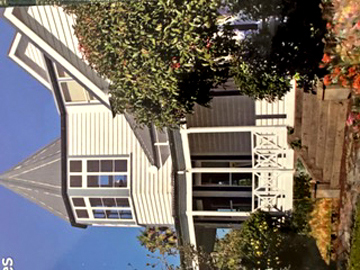
Frank
stood, unsure... the wooden gate was the same—he didn’t
remember the hedge. That ‘phone call, she may have thought him
impertinent. But the taxi had all ready gone. He straightened his
shoulders, repositioned his walking stick and smiled at the familiar
street.
A
laughing breeze from across the harbour picked two scarlet leaves
from the pavement and tossed them, like rustling lolly wrappers. Far
away, ‘Greensleeves’ called the local children for an
ice-cream.
His
glance swept the ridgeline of his old house. No change there! The
familiar belvedere still squatted in the centre of the roof; its six
sides of bevelled glass reflecting the early sun. He was home!
“Mr
Darvell? Please come on up.” From the top of the steps the
welcome in her cheery voice was unmistakable. The sweet savour of
crushed thyme among the flagstones, rose beneath his unsteady feet.
The stick helped him negotiate the seven familiar steps to the front
door.
He
limped towards where his hostess waited on the veranda. Frank looked
into the grey eyes of their snowy-haired owner as she held out a
hand. He juggled hat and stick. “So kind of you to see me.”
“I’m
afraid I may be trespassing on your kindness, Mrs Martin. I do hope
you don’t mind. This was my home as a small boy and after all
these years….” He followed the diminutive figure into
the hall. “How long have you lived here?”
“I’m
so pleased to see you. We came here eleven years ago, when my husband
retired. He is no longer with us, but I love this place ... such a
happy home, so bright and sunny with a perfect view over those
sparkling waters.”
“I
have never forgotten that view Mrs Martin.” As he followed her
into the living-room, Frank’s architect’s eye noted
several black and white sketches of familiar landmarks, Highwic,
Three Lamps and Monte Cecilia.
“Has
the place changed at all? We planted the hedge but I have kept it
trimmed, so we always have an outlook.”
“Would
you believe I’ve not been back since the day we left?”
They stood watching the gulls wheel and cry behind a homebound
fishing launch. “I was only six, that is almost eighty years.
Eighty years in which I have travelled the world…should have
returned sooner.” His gaze was far out to sea.
Conscious
of her visitor’s reverie, Laura, head tilted to one side,
waited. “Sometimes a backward look revives painful memories.” Her smile
was kindly.
He
returned her smile, “My thoughts, exactly, so many memories of
times gone by.”
“Please
sit down, Mr Darvell. I am so pleased you could come. I have many odd
questions to ask while we have a cup of tea.” Laura turned to a
door. “Do make yourself at home. Look around if you want to.
I’ll be in the kitchen.”
Frank
glanced about taking in the floral linen covers, and pleated
curtains. Odd questions, what did she mean? Sunshine streamed onto
the window seat where he sat, recalling family days. The hide and
seek games with Nina the home help— Snap, and Happy
Families on the blue patterned rug. He turned to the window,
to
the familiar view of North Head and Bean Rock surrounded by a
buoyancy of Dufy yachts and sudsy launches.
He
grinned at the sight of the spiral stairs, his eyes prickling at the
thought of roguish Barly in the belvedere. That turret-top gazebo,
which held nothing more than bare boards and a hanging hurricane
lantern. Barly, Frank’s own phantom creation had brought
shivers and goose bumps to the small boy on many a sleepless night.
In
charge of the dark, Barly the nut-brown urchin, creeping down the
stairs in the gloom to scare the socks off naughty children. He
cannily lurked in dark corners and mysteriously vanished when Nina
turned on the hall light. One glimpse of the little creature, and
Frank knew Barly would steal his mother forever.
He
stood looking at a seascape watercolour when Laura returned with a
tray. “Here we are, Mister Darvell.”
Limping
towards the armchair, Laura indicated, Frank leaned his hat and stick
against a bookcase. “I’m in a townhouse now, with a
minute garden. I used to enjoy looking after my roses, but with
this,” he pointed to his foot, “For the last four or five
years, I have no choice but to lie on my bed for a nap every
afternoon.”
Laura
smiled, understanding in her blue eyes. “I often do the same.”
“Yes,
even today, when I doze off, I dream of my childhood here. I was a
lonely child, but happy. Those dreams seem so real.”
Laura
reached across with a plate of cucumber sandwiches. “There’s
a special, what shall I call it, a special atmosphere about this
house. Tell me about your mother.”
Frank
lifted his cup and inhaled the hot tang of lap-sang souchong. “Mother
seemed always to be lying down, her bedroom was downstairs.
Apparently she had rheumatic fever when young. I usually played by
myself, sometimes with Nina the Help if she wasn’t too busy. I
suppose I was three, maybe four.”
Laura
smiled. “Not easy for an only child.”
“Mother
spent her days lying on top of her bed; she might read to me while
she knitted or hemmed silk scarves for church fairs.” Frank
glanced out the window—the gulls had gone. In an updraught on
the cliff face, a lone tern hung motionless, red legs trailing as if
waiting for a signal that mullet were gathering on the incoming tide.
“How
did you amuse yourself?”
“I
knew to be quiet. Sometimes Mother would read Peter Rabbit
or
Jeremy Fisher. I can still recall her lilac scent.”
He
held the cup half way. “I’d set my train tracks on the
sunny bits of the rug.” Frank paused, then, focusing on Laura,
spoke more quickly, “Her room was always warm and bright. She
died when I was six.”
“You
were so young. Do you think the house has changed?”
“Very
little. Inside I remember similar loose covers, it’s strange,
you’ve chosen much the same.”
Laura
refilled his cup. “You have an extraordinary memory. I expect
you would have climbed the stairs to the turret? Such a wonderful
view from the top.”
Frank
felt drawn to Laura as if to an old friend. He glanced from under his
brows. “Would you believe I had an imaginary friend called
Barly who lived in that turret?” Instantly, he wished he
hadn’t revealed this memory, as Laura, tilting the teapot,
raised her head. Their eyes held as if on hooks at either end of a
taut wire.
She
lowered her gaze and placed the teapot on its stand. “Tell me
about it.”
“Really,
there’s nothing to tell. I desperately wanted a playmate. I
dreamt up a little chap I called Barly … that he would be my
friend … it never happened of course. In fact, I was scared of
him … that somehow he would take my mother away. He would
disappear when a light went on. So…” he laughed
uncertainly. “Why am I telling you this?”
“Yes,
I suppose he would frighten you—especially with your mother not
being well.”
Laura leant back in her armchair, “I’m so glad you came,
you may be able to unravel a mystery for me.” The gold carriage
clock on the mantelpiece tinkled four and Laura rose to her feet.
“Come with me.” She walked ahead, back to the entrance
hall. What would you most like to see?”
“If
you don’t mind, I’d love to see my mother’s room
once more. Her room was on the ground floor.”
“I
do understand.“ Laura led him to the bright room with its
French doors. Squares of sun still burnished the polished floor and
splashed grids of gold on a circular carpet in shades of old rose.
“Is
it much changed?”
“Hardly
at all. This is the room I dream of when I lie down for a nap. It
seems—I’m back on the rug and playing with my toys.”
He glanced about. “Strange how fresh one’s childhood
memories can be.”
“The
carpet will be different.”
“In
those days the rug was blue. Intricate pattern, Persian I believe. “
Laura
moved to the end of the bed and sat on the patchwork coverlet, mellow
in its collection of multicoloured squares. She seemed to be watching
the yachts that floated like careless handkerchiefs on the lightly
ruffled sea. All the while her fingers twined in her lap. “Since
I’ve been alone, like you, I have a rest in the afternoons. I
want to ask you about…” Laura hesitated. “Shall I
call it a manifestation that occurs when I doze
off.”
Laura bent her head. “A little boy, dressed in an old-fashioned
blue romper suit comes to play on the rug. There, right where you’re
standing.”
Frank
looked down on the old-rose carpet, then glanced at Laura. He replied
as if her remark was perfectly normal, “How old is this little
boy?”
“I
would say, around four.” She smiled. “He’s very
good, very quiet. He doesn’t frighten me.”
“Is
he playing with a train perhaps?”
“Toys.
Maybe a model train? I never see him come. He is just ... there.”
Laura saw bewilderment in Frank’s eyes and spoke hurriedly. “I
have wondered about him for such a long time, four or five years,
perhaps.”
There
was an uncertain pause. “Does he say anything?”
Laura,
still on the end of the bed, raised her eyes. “No, but …
eventually, he just … disappears.”
A
cloud, like a single scoop of ice cream, settled in front of the sun.
The caramel boards and the old rose of the rug dissolved into a
shadowy grey like a faded photograph. They remained staring at the
round carpet.
“A
long time ago, this was a happy home. A peaceful place. I believe it
still is,” said Frank. He held a hand to Laura; she grasped it
and rose to stand beside him.
Laura
smiled, “You’re right; it has a grace all of its own.”
Frank
spoke quietly, almost to himself. “It’s a shame, but I
don’t believe that little boy will ever visit you again.”