Sara Etgen-Baker

© Copyright 2026 by Sara Etgen-Baker
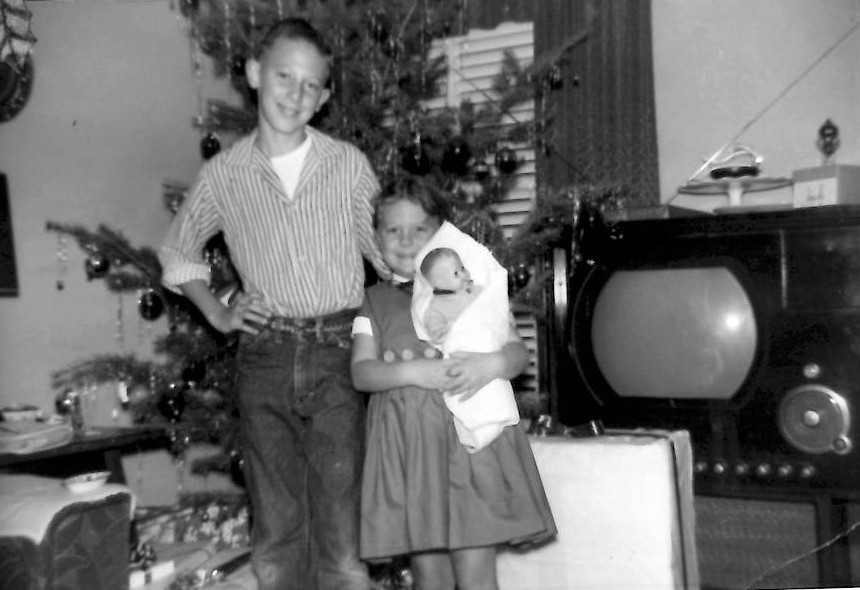
Sara and Dave and the Philco. Photo courtesy of the author.
| Technicolor Sara Etgen-Baker
© Copyright 2026 by Sara Etgen-Baker |
Sara and Dave and the Philco. Photo courtesy of the author. |
Christmas morning 1962 shimmered with a kind of magic only childhood can translate—half wonder, half mystery, all wrapped in the hush of a Texas winter morning. Our living room smelt of pine and Mother’s fruitcake, and the tree blinked in slow, sleepy rhythms like it was waking up with the rest of us. But something was different that year. We were still in our pajamas when we heard the station wagon’s car door slam. Then came the thud scrape shuffle of Dad maneuvering something large up the walkway. Mom peeked through the living room curtains, her hand flying to her mouth.
“Kids, look!” she said, astoundment in her voice, “your father’s bringing in… something, something huge.”
We scrambled to the living room window staring in disbelief. Moments later, Dad appeared in the front doorway, cheeks flushed from the cold, arms wrapped around a cardboard box so large it nearly swallowed him. Stamped across the side in bold, triumphant letters: RCA Victor — COLOR TELEVISION. For a moment, none of us moved. It felt like seeing the future arrive on our very own doorstep. Dad set the box down in the living room with a grunt, then straightened up, brushing snow from his coat sleeve.
“Well,” he said, trying to sound casual, “thought it was time we saw the world the way it really looks.”
We gathered around him like disciples at the foot of a miracle. He slit the tape carefully, almost reverently, as if opening a treasure chest. Inside, nestled in cardboard and promise, was the most beautiful thing we’d ever seen: a gleaming technicolor television set, its screen dark and waiting, its knobs shining like tiny chrome planets.
In the corner sat our 21 inch black and white Philco, squatty and faithful. For as long as I can remember, Phil as we called him, had been the glowing hearth of our evenings. His gray-white world felt normal to us—cowboys in dusty grayscales, Lucy’s antics rendered in soft charcoal tones, and the nightly news anchors in crisp shadows. Phil’s smoky gray colors felt normal to me. I didn’t even know TV could look different. Dad gently unplugged Phil, almost tenderly, as if saying goodbye to an old friend.
“You served us well, Phil,” he murmured.
We all nodded, because he had.
Then came the ceremonial installation. Dad crouched behind the RCA with the patience of a man determined to get it right the first time. He adjusted wires, tightened screws, and muttered things like any second now and almost got it. We hovered nearby, holding our breath, as if any sudden movement might break the spell. Finally, he stood.
“Alright,” he said with an excited catch in his voice. “Let’s see what she can do.”
He turned the dial, fiddled with the rabbit ears, adjusted the knobs again, and then—slowly, like dawn breaking, the screen flickered, hummed, glowed — and then came alive with color, real color—bold, blooming, breathtaking color that made our jaws drop and our hearts leap.
The test pattern burst onto the screen first, with reds that looked like fire, blues that felt like sky, and greens so bright they seemed to breathe. We all leaned forward instinctively as if we could touch them. Then came the local station’s morning broadcast, and suddenly the world I’d always known in shades of smoke and silver unfurled into something dazzling. The newscaster’s tie was a deep, impossible blue; the studio backdrop glowed in warm gold; even his face—so familiar in grayscale—looked startlingly alive and real.
We kids sat cross-legged on the floor, mesmerized. Mom kept saying, “Well, would you look at that,” as if the words themselves would anchor her to the moment. Dad explained how the set worked, though none of us really listened; we were too busy watching the world bloom.
Later that afternoon, we huddled together to watch Walt Disney’s Wonderful World of Color, a show we’d only ever seen in black in white except now it was like stepping into a childhood storybook. The castle glowed pink and blue; Tinker Bell’s trail sparkled gold; even the sky looked bigger, brighter, more hopeful. In the days ahead, we watched westerns where the desert sands finally looked sunbaked and real, commenting, “Gee! The Ponderosa isn’t gray after all.” We watched commercials, yes, even commercials, with the same reverence we gave to Sunday sermons.
Each time we sat in front of Ruth, our new RCA, gratitude filled our hearts, for she didn’t just replace Phil. She replaced the way we saw the world.