The Silent Suppression of Women in Maharashtra’s Water-Scarcity Economy as “Water Wives”
Tushar Sen
© Copyright 2026 by Tushar Sen
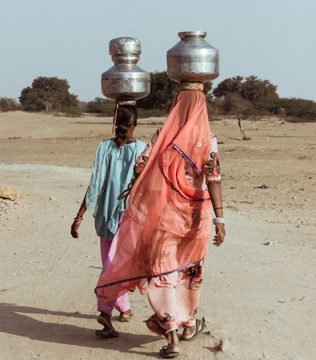
Photo by Simone Wenth on Unsplash
| Girl
Erased The Silent Suppression of Women in Maharashtra’s Water-Scarcity Economy as “Water Wives” Tushar Sen © Copyright 2026 by Tushar Sen |
Photo by Simone Wenth on Unsplash |
When the state fails to deliver water, families stop behaving like families—and start behaving like supply chains.
In parts of Maharashtra, a man marrying a second or third wife is often framed as a symptom of patriarchy, backwardness, or moral collapse. That diagnosis is convenient—and wrong. These marriages are not driven by desire, tradition, or belief. They are driven by logistics. When a household needs thousands of litres of water each week and the nearest source is kilometres away, marriage becomes a labour strategy. Each additional wife is not just a partner; she is another pair of hands walking miles under the sun, carrying survival back home. Strip away the outrage, and what remains is a system so broken that it has converted intimacy into infrastructure.
The instinctive response is to condemn the men at the center of these households—and some of that criticism is deserved. But stopping there is intellectually lazy. These arrangements don’t emerge in isolation; they emerge where tanker schedules are erratic, borewells have run dry, and state promises exist only on paper. In that vacuum, survival stops asking for moral permission. A second marriage becomes less a social decision and more a crude optimisation: divide the distance, multiply the carriers, stabilise the household. Under extreme scarcity, even the most personal institutions are repurposed into tools of survival.
Go to Denganmal, a village a few hours from Mumbai, and the abstraction collapses into something brutally physical. There is no piped water here. Every drop is carried on someone’s head across rocky terrain from distant sources that can take up to twelve hours to reach and return from. Women wake before sunrise, walk kilometres under a punishing sun, queue at shrinking wells, and return balancing heavy metal pots that cut into their neck and spine. This is not a chore; it is endurance labour. Backs give way. Feet crack. Dehydration becomes routine. And then the next day, it repeats.
Inside a household, this physical limit becomes decisive. One woman cannot sustain this and still run a home. So the system adjusts. A second wife is not a luxury—it is reinforcement. When one is exhausted, another walks. When one falls sick, another takes over. The household becomes a relay built on human stamina. The cruelty of it is not dramatic—it is mechanical. Day after day, the same distance, the same weight, the same damage accumulating silently in the body.
Some women enter these marriages knowing exactly what awaits them, but with few alternatives. In return, they get food, shelter, and a defined place within a functioning unit. Inside these homes, roles are distributed with cold efficiency: who walks, who cooks, who tends to children. It begins to resemble a labour system more than a family. The suffering here is not incidental—it is structural. It is built into the distance, the terrain, and the absence of infrastructure. Until that changes, the pattern does not break.
What makes this harder to ignore is that it exists alongside a long list of government schemes that were supposed to make it obsolete. The Jal Jeevan Mission promised tap water in every rural household. On paper, it is decisive—massive funding, clear targets, fixed timelines. On the ground, the story fragments. In parts of rural Maharashtra, “connected” households receive water for minutes a week, forcing people to buy water or walk anyway. Elsewhere, pipelines exist but don’t function, or projects stall midway. Announcements arrive on time. Infrastructure does not.
This gap between policy and reality is where adaptation begins. When systems fail repeatedly, people stop waiting. They solve the problem themselves, however crudely. In places like Beed, tanker dependence persists, groundwater remains unreliable, and drought cycles are predictable. Under those conditions, households reorganise around the only resource they can control: labour. Not elegantly, not ethically—but effectively enough to survive.
What gets erased in this conversation is what happens to girls growing up inside it. Because “water wives” is not just a marriage pattern—it is a pipeline that absorbs the next generation. The moment a girl is old enough to walk, she becomes part of the system. School becomes irregular, then irrelevant. Not because education lacks value, but because the household cannot afford to lose another set of hands. When water takes half the day, something else gives—and it is almost always the girl’s future.
This is how the cycle sustains itself. A girl who spends her adolescence carrying water does not build continuity in education or skill. By adulthood, her options are already narrowed. Entering a household as an additional wife is not a deviation—it is a continuation. The same labour, the same terrain, the same exhaustion, just under a different roof. What appears as a social anomaly from the outside is, from within, a closed loop: labour replaces learning, dependency replaces mobility.
And this is where statistics lose meaning. On paper, regions like Maharashtra show higher female literacy and better development indicators. But in drought-hit pockets, that advantage collapses in practice. You cannot compete with someone whose day is spent in a classroom if yours is spent walking for water. Over time, the gap compounds—not just in income, but in confidence, exposure, and the ability to imagine alternatives. The result is not just inequality. It is containment.
So the real cost of this system is not just the women currently carrying water. It is the quiet foreclosure of the next generation. By the time anyone notices, the pattern has already reset—another set of girls stepping into the same path, not because they chose it, but because nothing in their environment allowed them to step out of it.
At some point, the question stops being about what these families are doing and starts being about what the rest of us are willing to ignore. The distances are known. The drought cycles are predictable. The schemes are announced in advance. And yet, the outcome remains the same—women walking, girls dropping out, households reorganising themselves around absence. The term “water wives” survives not because it is accepted, but because it is necessary. And that is the indictment. Not of the people living inside this system, but of the one that left them there long enough for this to become normal.
Footnotes
“Water Wives: How lack of water in this Maharashtra village led to polygamy,” IndiaTimes,
“Jal Jeevan Mission,” Government of India, Ministry of Jal Shakti, https://jaljeevanmission.gov.in
“How the Jal Jeevan Mission failed Maharashtra’s villages,” The Wire, https://thewire.in/government/how-the-jal-jeevan-mission-failed-maharashtras-villages
“Central govt funds dry up, Jal Jeevan Mission works hit,” The Times of India, https://timesofindia.indiatimes.com
“Jalyukt Shivar Abhiyan,” Government of Maharashtra, https://en.wikipedia.org/wiki/Jalyukt_Shivar_Abhiyan
*****
Tushar Sen is a finance professional who also engages in sustained creative and scholarly writing. He is the author of Pandora’s Box, a collection of short stories available on Amazon, Barnes & Noble, and Audible. In 2020, he wrote and produced the short film Zulfi, which screened internationally and received 22 laurels across film festivals.
His essay, “Vishnu’s Umbilical Cord,” was published by LongformReads (https://longformreads.com/2026/03/28/vishnus-umbilical-cord-how-a-quantum-entangled-type-iii-civilization-answers-a-5000-year-old-question/).
His poetry has appeared in Lekh (https://lekh.co/the-poems-winning-aint-the-road-less-travelled-and-the-quill/) , Indian Review (https://indianreview.in/poetry/the-waiting-room-tushar-sen/), SpecPo Verse (https://specpoverse.org/vol-2%2C-issue-1-2026) and Afrocritik (https://afrocritik.com/roll-call-at-the-crumbling-girls-high-school-and-other-poems-by-tushar-sen/)