Ezra Azra

(c) Copyright 2026 by Ezra Azra
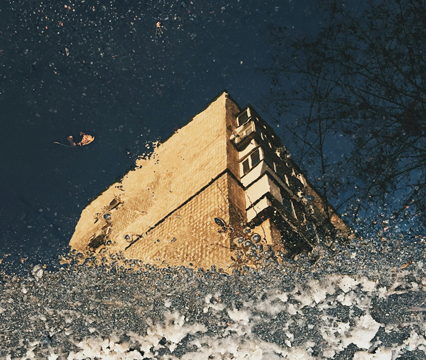
Photo by nastets at Pexels.
| The
First Time Ever Ezra Azra (c) Copyright 2026 by Ezra Azra |
Photo by nastets at Pexels. |
Even though everybody who kept abreast of the town’s public business could not have been surprised, the official announcement of the end yet had the effect of a catastrophic crisis.
The last nail in a coffin will always be allowed a stature beyond being a mere nail, the overwhelming sadness of the occasion being the principal culprit of that allowance.
The town had been the only and major commercial centre for the many mines as far away as a hundred miles away, through sparsely inhabited Arctic terrain in practically all-year Winter. The town’s port on the lake was, for most of the century, the country’s busiest for all grades of shipping.
It was the only centre for the traffic on the virtually countless rivers in the Province. Most rivers in the Province altered course from one brief Summer to the next, which fact explained why nobody cared to name most of the rivers during, between, and after the brief Summers.
The predominance of an excessively watery terrain utterly unpredictable from one season to the next probably guaranteed that foreigners would never care to become colonizers.
A far more notable feature of the Community, a feature everyone hoped would be continued into the Community’s second century because it was seen as a direct result of the severe and unstable weather, was the societal law-and-order in the absence of a Government Law Enforcement Office throughout the territory.
During all the years of the town’s commercial mining prosperity, the Indigenous citizens had purposely refrained from getting involved in all except one of the foreigners’ activities in the town.
That activity was school for children. The town had one school in which was taught seven grades. The school was by far the most impressive building in the town. By the end of that century, most of the teachers were Indigenous persons.
The schooling of their children by the mining foreigners was the only concession the Indigenous peoples allowed the foreigners. There was no use in the daily life of the Natives for any metals, and so they virtually ignored the feverish mining commerce brought by the foreigners.
Nature made it easy for the Natives by the fact that all ore mines were located in a relatively small area of the thousands of acres of Indigenous territory. Had it not been for the lure of the school, the probability was nil that Natives and foreigners would have found cause to intermingle.
Even in the school itself during the processes of education, there was studious separation in the seating in classrooms of children of foreigners and children of Natives; and, even more conscientiously, there was the separation of the children of the different Native tribes.
Except for casual communication and in the conduct of commercial trade, Indigenous culture frowned upon all inter-tribal activity. In time, as the number of teachers in the town’s school grew to outnumber the foreigner teachers, the Native tradition of preferred cultural isolationist independence showed signs of eroding from within.
At no time was the weather in the town predictable beyond a day-or-so, and it was never above cool in temperatures. Storms were the norm.
The strict though unwritten rule among the students and the teachers was that there were no romantic relationships between foreigners and Indigenous persons. It was a strict rule but so very easily lived by because the foreign students and teachers never saw themselves as permanent citizens of the town; that sooner or later they were destined to depart the town, forever; because, sooner or later, the mines would run out of ore.
Of the countless storms, the one that struck a few days after the announcement of the closure of that last mine, had the makings of the worst ever to crash the town.
The violent winds, and rain, and thunder and lightning were normal. The first-time ever rising of the rivers, undermined most of the buildings, and carried away many.
It happened in the middle of a school day. The school building was decimated within minutes. Parts of it were carried off by the winds and rain and rivers, with teachers and students inside, and never seen again. The once-in-a-century storm raged for the better part of two days. The town would never fully recover.
Over the next few days of calm, the central Government of the Country, sent in teams to help.
Angry Nature had done a thorough job; no bodies, dead or unconscious, were found. After seven days and nights the search for survivors and for bodies was ended. The first focus was on cleanup and reconstruction of the town.
Far away in nowhere somewhere in a lake, most of which was a temporary creation of the massive storm, a damaged section of a school classroom was afloat, drifting aimlessly, lopsidedly. Inside, were two bedraggled teacher colleagues, barely alive.
In the midst of the storm in the town they had grabbed each other and held on to each other fiercely for mutual protection as they were flung about by violent winds and roaring flooding waters and driven fragments of broken furniture.
They had survived so far because they had been wedged high up against a wall above a waterline by fragments of broken furniture. Simultaneously, they began to recover from unconsciousness.
Their clothes were in tatters. They were in such physical discomfort, their near-nakedness did not register. The amount of clothing fragments floating or snagged everywhere was clear indication of many more persons around earlier on.
Zombie-like they struggled, slowly and carefully and erratically, to disengage from each other, and to look for clothing pieces with which to clothe themselves.
They recognized each other as teacher colleagues. For the first few minutes it did not occur to them to be puzzled why they, two teachers from two classrooms at opposite ends of a hallway, had ended up entangled in the same smelly pile of storm debris high up a wall inside what must have been at sometime a classroom.
As awareness of their surroundings increased, each worked more intently at finding a place as far away from the other as possible as their seriously restricted circumstances permitted.
Sadly, their traditional cultural prejudices against each other were recovering and asserting themselves faster than the instinctive human cares of either self-preservation, or of mutual compassion.
“I’ve looked outside. I cannot even guess where we are.” “Me, too. Just water as far as the eyes can see. All fresh?”
They were self-consciously silent for a few seconds. Their speech degraded into diffident mumbling.
“By respected tribal customs, we were right to keep distance between us at school.”
“And everywhere else in the town.”
Again, self-conscious mutual silence. “To return, we must help each other do it separately.”
“And from different directions. And at different times.”
That agreement made the silence less tense.
“Am I confused, or was I in my classroom?” After a few seconds of meaningless casual silence,
“You are not confused. I was there that first-time-ever by sheer random happenstance, having taken a wrong turn to avoid the storm.”