In
the forest, ants usually live underground, even if only partially.
This
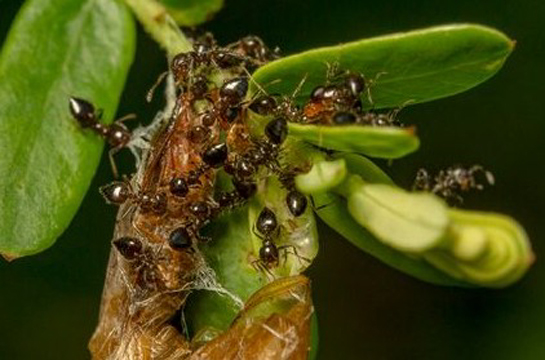
story is about a family of ants who lived high up in a nest they
built in a tree in a valley deep in a dense jungle.
The
tree was very, very old and huge. It had lots of branches and leaves
and flowers and sweet berries. The berries were the food the ants
lived on. There were so many berries during Summer that the tree ants
always managed to save enough food to eat during Winter and Spring
when no trees in that jungle bore fruit.
During
snowy seasons, the higher the snowfall, the more the ground ants
benefited from the warmth generated under the snow cover.
High
up in trees, there never is enough snow accumulation to generate
warmth. Instead, ants have to apply their natural engineering genius
to constructing nest exteriors that prevent snow accumulation on
surfaces, because snow accumulation would add dangerous extra weight
to a nest perched on a branch.
Another
advantage ground ants have over tree ants is that whereas underground
expansion of a nest is virtually unlimited; it is significantly not
so in a tree.
The
tree ants were perfectly content most of the time. Sometimes they
were bothered by the teasing and the taunting by ants who lived in
underground nests.
Ants
living in nests in trees are considered to be downright weird by
land-living ants, if only because there is a much, much higher
mortality rate among ants in trees.
For
instance, in wind and rain while ants on the ground easily take
shelter, ants in trees are never safe from the chaotic blowings-about
of leaves and branches.
As
well, for ants, eluding predators is easily successful more times on
the ground than on tree leaves and branches.
Why
the tree ants built high up in a tree was a mystery that only a few
oldest ants remembered.
Many,
many generations earlier, ancestors of the tree ants had dared to
build a nest high up in a tree because ant-eating animals on the
ground were decimating those species of ants that built nests that
were partially underground and partially aboveground.
Species
of ants that lived entirely underground had nothing to fear from
ant-eating animals on the ground, as long as the ants built their
nests deep enough to elude the phenomenal sense of smell of the
ant-eaters.
After
the ants took to building their nests high up in a tree, the
ant-eaters stopped entering the forest because their easy food supply
diminished significantly.
Nonetheless,
the tree ants were not about to return to building nests partially
above ground.
Having
a nest high up a tree had one serious problem. An ant nest built on a
branch was always the cause of the branch, within a few seasons,
withering. The nest had to be re-located.
Most
serious is if ants find a natural hole anywhere in a tree, and build
a nest inside that hole. Once inside a hole, there is no limit to how
far the ants can ramify their nest inside a tree. Most trees that die
naturally in a wild forest, die from within because of burrowing
insects, like ants.
Unlike
tree ants, underground ants can build nests that last for centuries.
Underground
ants expertly engineer their nests to be able to exploit pockets of
air that prevent underground water from flooding most of the nest.
Flooding
is the only natural seasonal disaster from which underground ant
nests might not recover.
Next
to invasion by an ant-eater, only a volcanic eruption producing
flowing molten lava can both permanently destroy an ant nest and
persuade ants to never re-build on the site.
There
came a time when some of the adult children in later generations of
the tree ants who knew nothing of the former danger from ant-eaters,
extinct in that forest, could not take the teasing and taunting
anymore.
They
decided to leave the tree and go build themselves a home underground
like the other ants.
The
rest of the family were sad that some of the adult children ants
wanted to leave. However, they said they would help the children, as
long as the children would live deep
underground as the other ants,
and
not revive the ancient tradition of living partially above ground.
The
children agreed. A day was set. The children ants prepared to leave
the tree.
Their
last night in the tree came. They were packed and ready to leave.
After the family had a going-away party, everybody went to sleep.
That
night a once-in-a-lifetime ferocious storm hit the valley. The strong
winds battered the valley from all directions, simultaneously. The
rain was so heavy it made the night darker than it actually was.
There
was thunder. So loud it kept everybody awake.
There
was lightning. So bright it hurt even closed eyes facing it.
The
storm raged the whole night. It died away only when the sun came up
the next day. The ants who were leaving the tree were very glad they
did not have to leave in a storm.
When
they stepped outside their home high up in the tree they saw the
whole valley was deep under water. The heavy rain had turned the
valley into a lake.
The
ants could not leave the tree. They had to wait many days and nights
before the water subsided and left the valley.
This
wasn't so bad because their tree was the only one that had been
strong enough to survive the storm with most of its berries. The tree
ants still had more than enough food for the whole time the valley
was under water.
When
those tree ants who wanted to leave the tree went down to the ground
they found all the ants sad who lived underground. The water hadn't
reached their underground homes, but the water had washed away all
the food they could have gathered to store away for Winter and
Spring. They would starve during the next Winter and Spring.
The
tree ants told the ground ants there was enough food in the tree for
everyone to share. The tree ants helped the other ants to pluck
berries to store for Winter and Spring.
The
ground ants never teased or taunted the tree ants anymore. All the
ants became best of friends.
Contact
Ezra (Unless
you
type
the
author's name in
the subject
line
of the message we
won't know where to send it.)